
Rhythm and Pacing
A tempo-ary interlude
This might feel like a tangent from our discussion of beats in scenes, but think of it more as an interlude that gives you time and space to process what we’ve been talking about and illustrate a place where it’s useful. We mentioned in the last post that doing a beat analysis can help you see and understand how the rhythm and pacing of a scene or work are executed. But what exactly are rhythm and pacing, and how do beats help us see that?
Like “beat”, rhythm is a borrowed concept. This time we’re stealing from music, or poetry. Rhythm is a property intrinsic to how the specific words and phrases of the work play out. The way one word follows another, how characters talk back and forth to each other, the pattern of stress in how it’s all put together. Think of it as the ba-dum ba-dum ba-dum element of the prose.
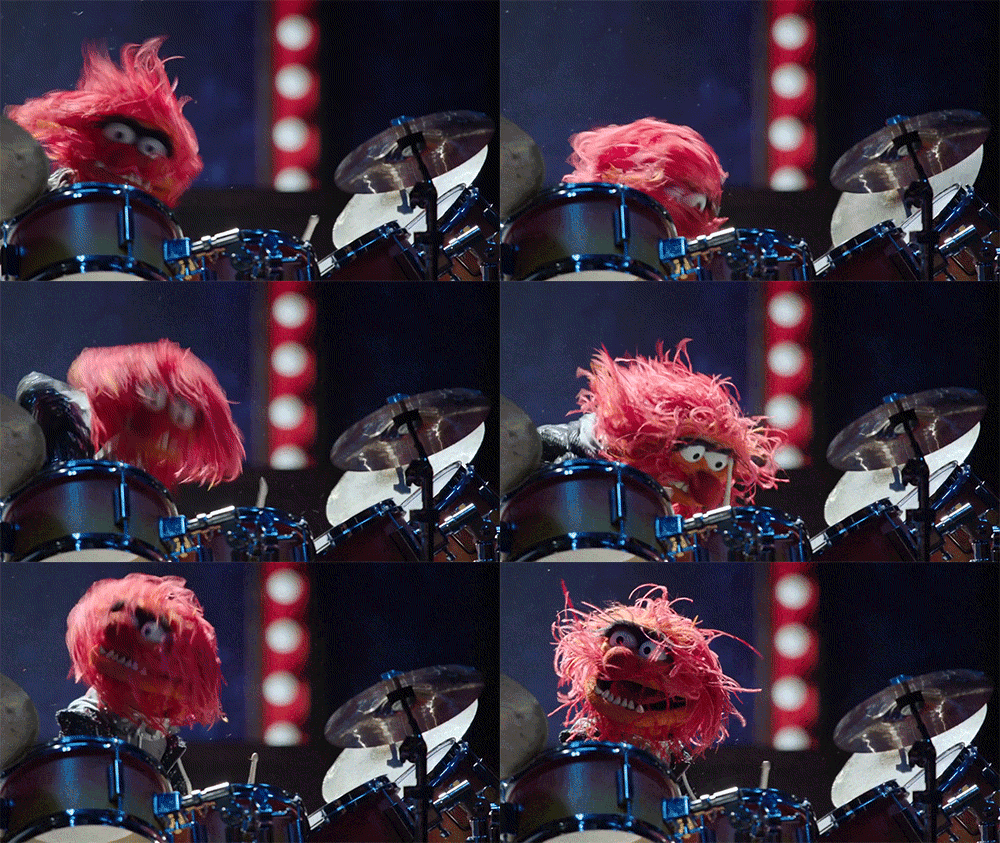
The rhythm doesn’t change whether you read the words at a fast clip, or slow them down.
Pacing, on the other hand, has more to do with how fast or slow we’re inclined to go as we read a scene or work. Tight, fast pacing calls for short sentences. Short scenes. Quick changes. Slower, more methodical pacing allows for longer sentences, more elaborate or complex constructions, and chewy, variegated language. If you think about this like a drummer, then rhythm is the pattern of beats you strike. Pacing is how quickly you tap those beats.
How do scene beats play into this? They give you a way to capture the pacing in a scene. If your beats are very long and full of dense paragraphs, you’re probably looking at slow pacing. On the other hand, if your beats are shifting constantly, the pacing is probably pretty fast. Most works don’t have rigidly consistent pacing throughout, and a beat analysis can capture how the pacing changes over the course of the work.
While rhythm is mostly an element at the word, phrase, and sentence level of a scene, some works have prose where the rhythm can be analyzed at the scene level. If you continue to think of rhythm as a trait defined by placement of stress, not speed, paragraphs can have a rhythm if they induce stress at a certain point.

Perhaps the opening line of each paragraph has a staccato emphasis that tapers off as the paragraph unfolds, before returning at the top of the next paragraph. At the same time, a scene might have a rhythm, often captured by the interaction of dialog and prose, but sometimes done within those elements independently. Some literary genres are more likely to have clear, analyzable rhythm at these levels than others. For the works where it’s present, a beat analysis can work very well to see how that was done.
Even when the craft of a piece isn’t concerned with rhythm enough for it to lend itself to a beat analysis at that level, you can still use this technique to dig into how rhythm that is present interacts with the other elements of the work. (Like with theme, everything has a rhythm at some level. It may not be a consistent or thoughtfully crafted element, but it’s there.)

If you break a scene into beats, then track the rhythm of the prose, you should be able to see how changes in rhythm do and don’t align with the other shifts happening in the scene. For looking at another work, this can give you insight into how wordsmithing impacts the larger experience of the piece. Do the rhythm changes align with beats? Carry readers across those boundaries? Tie different beats together or echo across different threads of the story?
For analyzing your own work, it can help you diagnose problems. Are readers stumbling over the prose in certain spots? Or is their attention or focus misaligned with where you want it? You might be able to reconfigure or shift the rhythm in critical areas to support the other elements you have at play and resolve those issues.
A lot of the tools we’ll discuss here have one thing in common: they give you a way to look at your work with some distance, or objectivity. They’re a shortcut to the approach that often comes naturally when you stick your work in a drawer for a while. Beats are a particularly flexible tool for helping you do that. Next time we’ll discuss how to think about them in this context in more depth.