
Nonlinearity and Plot
The wibble wobbles are coming soon to a post near you
Structure can be nonlinear, and that lets us do some really fun stuff. But structure doesn’t get the monopoly on this mayhem; plot can be nonlinear, too. Remember, plot is the sequence of events that occur in a story. If you’re noticing that plot has a much simpler definition than structure, well, it does. A consequence of that is that nonlinear plot happens much, much less often than nonlinear structure, and is a bit easier to discuss. If the sequence of events happens in order, from the internal perspective of the narrative, then the plot is linear, even if the way the reader encounters it is nonlinear.
Admittedly, defining plot this narrowly, then insisting that events must occur out of order for plot to be nonlinear feels a bit silly at first.

Looking at things this way, the vast majority of nonlinear plots require time travel. When you start to chew it over, though, this is less silly than it might seem. We’ve discussed the difference between choices made for internal consistency of a narrative compared to ones made for direct interaction from awareness of an audience a lot, and this distinction goes right to the heart of that. A nonlinear plot does not involve the audience at all. It just is. A nonlinear structure is entirely about how things are presented to the audience. This difference has a huge impact on how nonlinearity interacts with the other elements of your narrative and what you have to do to successfully render that nonlinearity.
We’ll dive into the details on implications and audience effects for nonlinearity later. For now, lets zoom in on nonlinear plots and what they look like.

The trick we’ve suggested for finding the plot in a narrative is to look for the part where you describe it by using the phrase, “And then...and then…” A variation on this helps recognize that not only is this the plot, but it’s nonlinear. If, as you go along, you find yourself saying, “And then, way back before all that…” you might have found yourself a nonlinear plot.
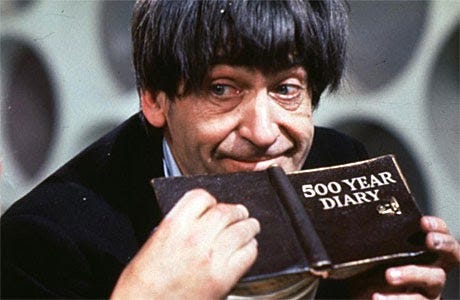
It’s possible you’re following the presentation of linear events in a nonlinear structure, but you can check for that by asking yourself whether those events actually happened earlier, and you could have told them in order, or whether the things set in the past do, in fact, happen at that moment in the narrative.
This can cause arguments, and the arguments start to look like classic time travel paradoxes pretty quickly. Time travel paradoxes are fun, but needlessly complicated for our analytical purposes. Instead, if you’re fuzzy on whether you’re looking at a nonlinear plot or a nonlinear structure, pick a perspective or point of view that you think is the most important one for grasping the narrative. Often that’s a character point of view, but it might be the setting’s, or the world as a whole. Then chart their experience of the plot against a linear timeline. Does it have discontinuities, repetitions, or loops? Nonlinear! If not, your plot’s linear. Don’t stress if the answer changes for different choices around POV. Often narratives have multiple plots, and they might not all be nonlinear. Or, you might be looking at a narrative where it is, in fact, ambiguous whether or not the plot is nonlinear. Remember, we’re not trying to find declarations of objective truth about a work; we’re trying to understand it. Noticing that a plot appears nonlinear from one perspective and not another? It’s going to be really hard to walk away from that without developing some depth to your understanding of what’s going on.
Got it? If this still hasn’t quite clicked, don’t sweat. Thursday’s post will be thought exercises with examples to help you work it out. That’ll be a free one. Monday will be the first part of a two-part subscribers-only practical exercise, with part two coming closer to the end of this unit.